
I once paid an AI to be busy. Not productive. Busy. I gave Vera, my own research agent, a task and what I genuinely believed was an instruction. “Pull the market view, make it solid.” She ran. And ran. Forty minutes of looking deeply employed, and at the end she handed me something confidently wrong, beautifully formatted, and entirely beside the point.
I had not given her a job. I had given her a vibe. And without a loop to close, a vibe is all she could ever chase.
That is the shift I want to talk about, because it is the one I keep watching people miss. The skill is no longer prompting. The skill is engineering the loop.
What loop engineering actually is
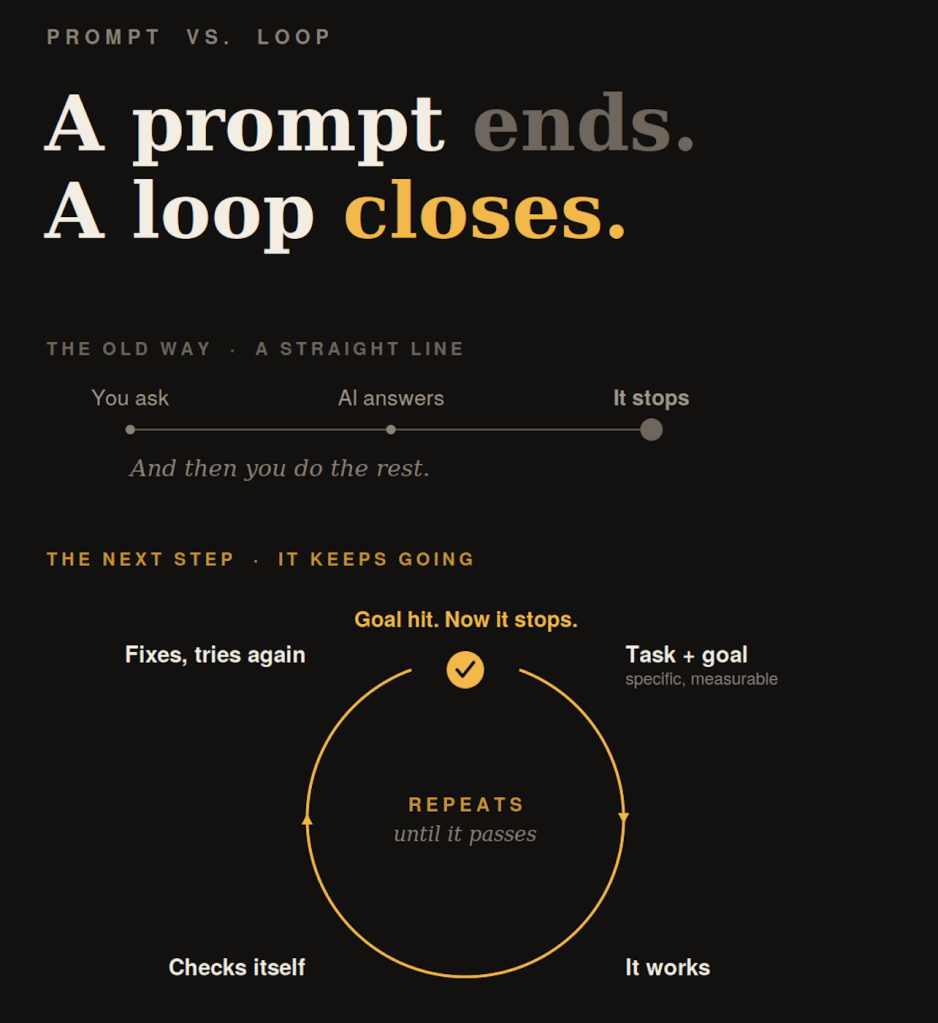
Prompting is a single move. You ask, the AI answers, it stops, and then you do the rest. The checking, the fixing, the deciding whether it is any good. You are the loop. Every turn comes back to you.
Loop engineering is a different shape entirely. You give the AI a task and a goal and then you let it keep going. It works, it checks its own output against the goal, it finds the gaps, it fixes them and it tries again. It only stops when the goal is actually hit.
Read that last line again, because it is the whole thing. The goal is the stop sign. Not a suggestion the AI drifts toward. The literal condition that ends the work. That is exactly what I had failed to give Vera. A task without a finish line is not a delegation. It is a treadmill.
The difference between a good goal and a vibe
Here is where it gets practical, and where most of us quietly get it wrong.
A goal only works as a stop sign if the AI can score itself against it. That is the entire test. Can the model look at its own output and know, on its own, whether it passed. “Make it good” fails that test. The AI cannot measure good. It has no idea when it is done, so it either stops too early or wanders forever. That is not a goal. It is a mood.
“Every claim backed by at least three working sources, ninety percent accuracy against the checklist, nothing skipped” passes the test. Every part of that is countable. The AI can tally the sources, open each link, run the checklist and tell whether it cleared the bar. A specific, measurable goal turns the AI from something that guesses into something that grades itself.
Vague goal, the AI cannot score itself and never knows when it is finished. Specific goal, it can, and it does. The whole quality difference hides in that one move.
The loop is also a lie detector
The clearest example I have seen is the one most of us have already been burned by. Sources. Ask an AI for a brief with references and, without a loop, it will happily hand you a tidy list of links. Some real. Some confidently invented, pointing at pages that never existed. It writes the citation and moves on, because nothing in the process ever forced it to check.
Put a loop around the same task and the behaviour changes completely. The AI writes the brief, then goes back and opens every link it cited. It confirms each one actually loads and actually backs the claim it was attached to. The dead links and the invented ones get thrown out, and it keeps working until every claim has real, working sources underneath it.
Same model. Same prompt. The only thing you added was a goal it had to verify against and a loop that made it keep going until it got there. That is loop engineering in one picture. The intelligence was already in the box. What was missing was the instruction to not stop until it was right.
Why this is the genuine next step
For two years we treated prompting as the destination. Write the cleverer question, get the cleverer answer. It was a real skill for about eighteen months, and then the models got good enough that the cleverness stopped mattering. A decent prompt and a brilliant one increasingly land in the same place.
So the curve moves. The next skill up is not a sharper question. It is a clearer finish line. You stop optimising the input and start engineering the conditions under which the work ends.
That is loop engineering and yes, it is exactly the next step. It is the move from talking to the AI to genuinely delegating to it. Prompting taught us to ask well. Loop engineering teaches us to define done.
This is the line between Copilot and Cowork
Hold the two apart and the whole point snaps into focus. Copilot is the one you prompt. You stay in the loop yourself, on every turn. You are the verifier. It drafts, you check, it drafts again, and the loop runs through your hands. That is the right shape when you want a thinking partner sitting next to you, making you faster without leaving the room.
Cowork is the one you set loose. You hand it the outcome and step away and it runs the loop without you. Which means the loop has to be able to close on its own. And it can only do that if you engineered a goal it can verify against. Loop engineering is not a nice extra for Cowork. It is the thing that makes Cowork safe to hand work to at all. No defined finish line, no safe delegation. You are just leaving an unsupervised intern alone with your reputation.
There is a small practical kicker too. Cowork keeps going until the goal is met and every lap of that loop is real work being done. A vague goal does not just give you a worse answer. It lets the thing run longer than it ever needed to. Define done well and it closes fast. Leave it open and it circles. The finish line is doing double duty, quality and effort at the same time.
So the shift is smaller than it sounds
When people ask me what skill to pick up next, I have stopped saying prompting. I say this. Get good at defining done.
Loop engineering sounds like a technical trick. It is not. It is the much less glamorous discipline of saying what you actually want, precisely enough that something can hold itself to it. And we are bad at it, not because the tools are hard, but because we have spent our whole working lives running on shared assumptions and read the room judgement. We carry the unspoken definition of finished in our heads. The AI does not come to the room. It comes to the instruction. And most of our instructions, it turns out, were vibes we never had to make explicit, until now.
The machines just made the difference impossible to hide. They will be busy, gloriously busy, for as long as you let them. They stop when you tell them what finished looks like. That is not a prompt. It is a sentence you write before you press go. And almost nobody writes it.

