
For the last few years, we have been teaching everyone how to use AI. How to prompt better, how to use Copilot, how to build agents and, increasingly, how to hand over complete tasks instead of simply asking questions. But while we have been focused on adoption, something else has quietly started to change: AI work is becoming measurable consumption.
If you are using Microsoft Copilot Cowork, you can already see this yourself. Open a Cowork task and type /cost. Microsoft uses this command to give you insight into the approximate Copilot Credit consumption of the task you are working on. You can also see information about your monthly consumption and remaining credits, and you can return to an earlier Cowork task and use /cost there as well. Checking /cost itself does not consume additional Copilot Credits. Microsoft does make an important distinction here: this is an estimate intended to give the user visibility into consumption, not an itemised invoice or the authoritative billing record. Microsoft documentation: Check Copilot Credit usage with /cost
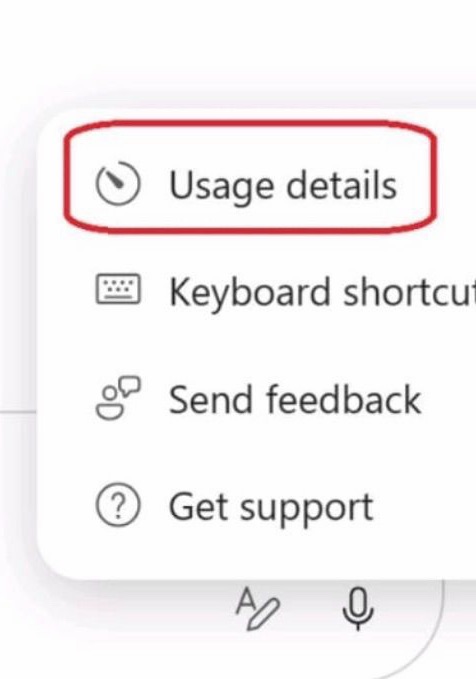
There is now another way to make this visible that is even easier to overlook. In the Cowork interface you can click the three dots (…) in the top-right corner and select Usage details, as you can see in my screenshot. It looks like a tiny product feature, but I think it represents something much bigger. We are slowly moving from AI that feels almost invisible from a cost perspective towards AI where employees can actually see that the work they delegate consumes resources.
From AI adoption to AI economics
Until now, most conversations about Copilot adoption have focused on questions such as: how many people have access, how many people are active, how frequently are they using Copilot and how many agents have we created? Those are useful questions, but they tell us surprisingly little about the actual work being performed.
Imagine two employees who both say they used Copilot today. One person asks AI to rewrite an email. The other asks Cowork to research a topic, retrieve organizational context, browse additional information, reason across that information, use several tools and produce a finished deliverable. Both technically “used AI”, but these are completely different pieces of work and they can have completely different consumption patterns.
That is important because Copilot Credits are Microsoft’s common currency for eligible usage-based AI experiences. Consumption isn’t simply a case of one prompt equals one credit. Depending on the experience and task, consumption can be influenced by things such as the model being used, the context retrieved, the runtime needed to plan and execute the work and the tools being called. Microsoft documentation: Understanding Copilot Credit consumption
And that is where I think we need to change our mental model. We shouldn’t only count prompts anymore. We need to start thinking about work.
A prompt can be a simple question that takes seconds to answer, but a prompt can also become the starting instruction for an agentic task involving multiple steps, tools and actions. As AI becomes capable of performing increasingly complex work on our behalf, “number of prompts” becomes a pretty poor measurement of what is actually happening.
Try /cost, but don’t try to win by having the lowest number
If you have access to Cowork, try this with a real task. Give Cowork something meaningful to do and afterwards type /cost, or open … → Usage details, and look at the consumption.
But please don’t immediately ask yourself: How do I make that number as low as possible?
That would be the wrong lesson.
If AI consumes €5 worth of resources but saves €300 worth of human effort, the €5 probably isn’t the problem. At the same time an AI action that appears extremely cheap but gets executed unnecessarily thousands of times can still create considerable cost without creating meaningful value. Cost by itself therefore tells us surprisingly little.
The better question is: What did we get back?
That sounds like a small difference, but for organizations it changes the entire conversation. We shouldn’t optimize for the lowest possible AI consumption. We should optimize for the highest possible value from the AI we consume.
Please don’t create the AI police
Because I can already imagine the management meeting. Someone opens the dashboard and says, “Femke used 8,000 Copilot Credits this month. Jan only used 900.” Everyone looks approvingly at Jan. 😂
Please don’t do this.
Maybe Femke used those credits to automate work that previously required twenty hours of human effort. Maybe Jan used his credits to generate fourteen slightly different versions of an email. Without understanding the work and the outcome, the consumption number tells us very little. High AI consumption isn’t automatically bad and low AI consumption isn’t automatically good. In fact, if an organization genuinely becomes AI-first, I would expect some of its most valuable processes to eventually become significant consumers of AI.
That is why I would much rather see organizations connect four things:
AI consumption → work performed → human effort assisted → business outcome.
The first part is becoming increasingly measurable. The last part is where the real transformation work begins.
The organization can see much more than the employee
The individual /cost experience is only one side of this story. Microsoft is also building the organizational management layer around Copilot Credits. Administrators can use Microsoft 365 admin center → Copilot → Cost Management to understand consumption across services and drill further into usage. Microsoft also provides spending policies so organizations can manage how usage-based Copilot capabilities consume credits. Microsoft documentation: Manage Copilot Credits and Cost Management
Cowork reporting takes this another step further. Organizations can look at usage such as active users, tasks and activity patterns, and Microsoft has been connecting usage with concepts such as credits spent and estimated assisted hours. That last metric is especially interesting, although Microsoft correctly warns that assisted hours are estimates and shouldn’t automatically be interpreted as proven productivity gains or actual hours saved. Microsoft documentation: Copilot Cowork usage report
Put these pieces together and you can see where this is going. Employees get more visibility into what their own AI work consumes, administrators get visibility across the organization, Finance can start understanding where AI spending is going and business leaders have to start answering the hardest question of all: is that consumption actually creating value?
Welcome to AI FinOps
Cloud went through a similar learning curve. At first, the exciting part was that everyone could consume infrastructure whenever they needed it. Then consumption exploded, the invoices became more interesting and we discovered that organizations needed a discipline around understanding and optimizing cloud economics. FinOps became part of running cloud at scale.
I think agentic AI is going to create a similar challenge, except this time we aren’t just talking about servers, storage or compute. We are increasingly talking about something that looks like digital labour.
An employee might interact with AI twenty times during a working day. An agent can potentially execute far more actions in the background. Those actions can involve models, organizational context, browsers, tools and other services. As we move further into agentic work, AI consumption therefore stops being simply a licensing discussion and becomes part of the operating model of the organization.
Finance can’t solve that alone. IT can’t solve it alone. The AI team can’t solve it alone either. Business leaders need to understand which work is being delegated to AI, IT needs to understand governance and consumption, Finance needs visibility into the economics and the people building agents need to understand not only whether their agents technically work, but whether the economics make sense.
And employees need some awareness too.
Not because everyone should calculate Copilot Credits before sending a prompt. Please don’t turn AI into the office printer where everybody becomes terrified of accidentally printing in colour. But people should increasingly understand that there is a difference between asking a model a simple question and delegating a complex piece of work involving multiple models, tools and actions.
That is AI literacy too.
Sometimes the right answer will be: spend more
There is another side of AI cost management that I think is easy to miss. Good cost management shouldn’t automatically mean reducing AI consumption.
Imagine an agent costs €20 to run but replaces €500 worth of repetitive manual work while producing the same or better outcome. The interesting optimization isn’t necessarily getting that €20 down to €15. The much more interesting question might be: why aren’t we using this agent more often?
That is why I think organizations need to be careful with the word “cost”. Cost immediately pushes our brains towards reduction, while the more useful concept is unit economics. What does a piece of AI-enabled work consume, and what value comes back?
Once you start thinking that way, completely different questions appear. Which tasks deserve more intelligence? Which repetitive processes should become agentic? Where are we using expensive AI for low-value work? Where are employees doing expensive manual work while an AI alternative would cost almost nothing? Which agents are creating measurable value? Which agents are simply very sophisticated ways of burning credits?
Those are questions worth answering.
That tiny “Usage details” button is bigger than it looks
This is why I find such a small interface change fascinating. /cost and Usage details aren’t the most spectacular AI features Microsoft has released. They won’t generate a flashy keynote demo. But they represent a shift that I think is going to matter enormously.
The first phase of generative AI was about access. Give people AI. The next phase was adoption. Teach people how to use it. Then came agents. Give AI tools and allow it to perform increasingly complex work.
Now another phase is beginning.
Understanding the economics of digital work.
So if you have access to Copilot Cowork, try it. Give Cowork a meaningful task, type /cost or open … → Usage details, and look at what it consumed.
But don’t stare at that number and ask whether it is high or low. Ask something much more useful:
What work did AI just perform and what did I get back?
Because I suspect that within the next few years, one of the most important AI metrics won’t be how many employees used Copilot or even how many agents an organization has.
It will be whether the digital work those humans and agents are consuming creates more value than it costs.
And that is when AI adoption becomes AI economics.

