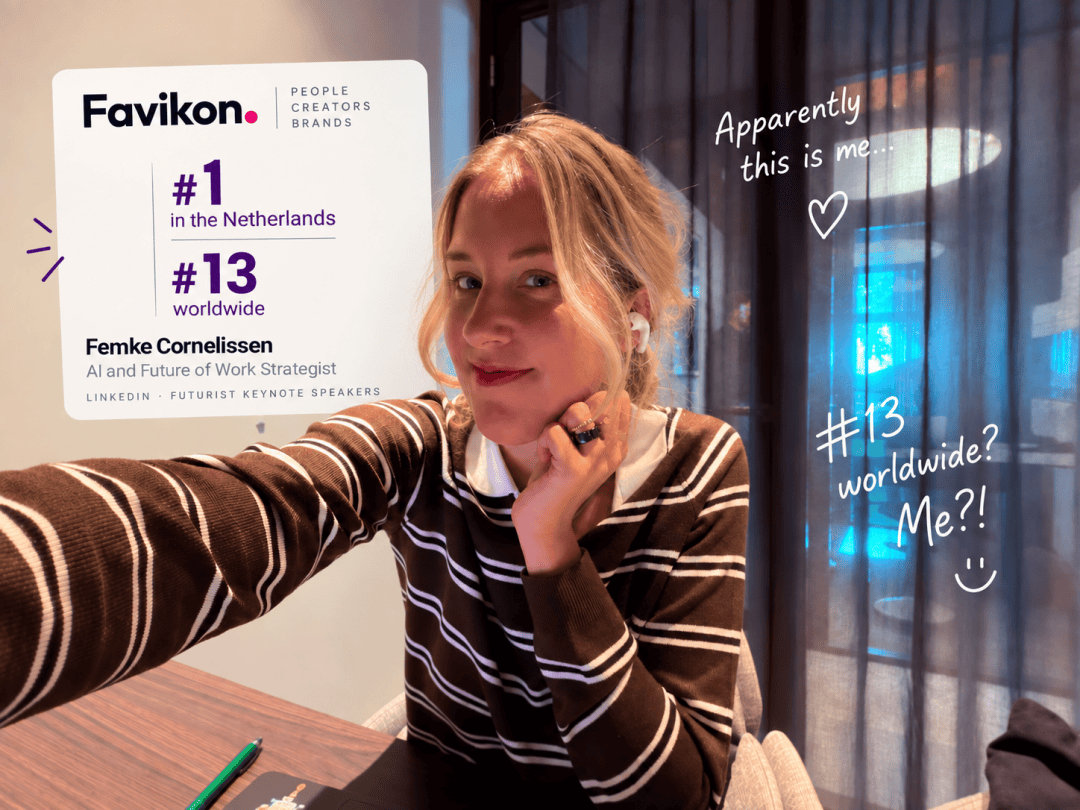
Over the past few months, I have seen Favikon everywhere on LinkedIn. Top AI creators, top speakers, people to follow, country rankings, worldwide rankings. Sometimes the person sharing the list is on it. Sometimes they aren’t. Sometimes twenty people are tagged, half of them respond and before you know it, the same list has travelled through your feed three times. And then my own face started appearing. Apparently, I am currently #1 Futurist Keynote Speaker in the Netherlands and #13 worldwide in Favikon’s LinkedIn ranking. Number one in the Netherlands? Very cool. But #13 worldwide? Oh my God. 😂 I genuinely laughed when I saw it. Not because I don’t appreciate it, I absolutely do, but #13 in the world sounds so enormous that my next thought was immediately: but what does that actually mean?
And I realised a lot of people didn’t know. You have seen the rankings, liked posts about them, congratulated people and knew my own number. But if somebody had asked me what Favikon actually measures, how the scores are calculated or why someone ends up in a particular category, we all couldn’t really have explained it. So I started reading. And that was actually much more interesting than my ranking.
First of all, Favikon is not LinkedIn 🙂
A Favikon ranking is not an official LinkedIn ranking. Favikon is an independent creator analytics platform that analyses creators across social media and uses its own methodology to calculate scores and rankings. So LinkedIn has not secretly created the World Championships of Keynote Speaking. Nobody watched every keynote speaker on Earth and eventually decided: “Yes. Femke. Definitely thirteen.” 😂 Thank God.
Favikon is measuring something else: your digital presence and influence. And it isn’t simply counting followers. Its Authority Score looks at audience, engagement and views. Those signals are weighted and combined, and Favikon also uses what it calls recalibration, intended to reduce the impact of unusual growth patterns that might not reflect longer term organic engagement.
That is already interesting because we often use follower count as shorthand for influence, while the two are clearly not the same thing. You can have a huge audience that barely sees or interacts with your work. You can also have a smaller audience that reads, comments, shares and comes back. Reach is not engagement. Engagement is not expertise. And followers are definitely not the same thing as impact.
Favikon is trying to capture more of that picture.
The number is relative, not absolute
This is probably the most important thing I learned. Favikon uses a centile system, which means it doesn’t only look at your raw numbers but also at how your performance compares with other creators in a relevant group. So if your engagement performs very strongly compared with the rest of that group, that matters to your score. But the important words there are “that group.”
Favikon doesn’t simply throw everyone on LinkedIn into one giant bucket. Creators are organized into industries and hundreds of niches. A creator gets a primary niche and can also have secondary niches. That classification influences who you are being compared with.
And this is where the big ranking numbers suddenly need a little context. If I am #13 worldwide in a particular Favikon ranking, that doesn’t mean I am objectively the thirteenth best person in the world at my profession. It means I am #13 within that specific ranking, based on Favikon’s data, classification and methodology. Still very cool. Just slightly less Olympic Games. 😂
It also means rankings can move without somebody suddenly becoming dramatically better or worse at what they do. If a creator is classified differently or the comparison group changes, the relative position can change too. That is important to understand when we see a nice graphic saying someone is “Top 10 worldwide”. The number is real within that system, but you need the category and methodology to understand what it actually tells you. There is more than one kind of influence
This part made me think beyond Favikon too. We throw the word “influence” around very easily, especially on LinkedIn, but influence can mean very different things. Someone can have enormous reach. Someone else can have a smaller but incredibly engaged community. Another person might barely post but be enormously influential inside boardrooms or a particular industry. Someone can be famous online and have little impact offline. Someone else can have huge business impact and almost no social media presence.
Those things aren’t interchangeable. Favikon is measuring a particular part of influence: observable digital performance. That is useful information, but it isn’t the whole story.
My Favikon score doesn’t know what happened after one of my keynotes. It doesn’t know whether someone changed a decision because of something I said. It doesn’t know whether a leadership team redesigned a process, whether somebody finally understood what AI could mean for their job or whether a conversation eventually turned into a transformation programme. And that is fine. That isn’t what it is measuring.
I actually like the ranking more now that I understand that. I can appreciate it as a signal without pretending it is an objective score for expertise. And then there is another interesting effect happening on LinkedIn
Once I understood the rankings a little better, I started paying more attention to how they are being shared. And something interesting happens. The people publishing Favikon lists are not always on the lists themselves. They want more followers.
Someone gets access to a Top 20 or Top 100 and publishes it. Twenty people are tagged. Those twenty people get a notification. Some comment. Some repost. Their networks see the post. Other people discover the list. The person who originally published it becomes part of the conversation too. I don’t mean that negatively at all. Actually, it is pretty smart.
Some Favikon ranking information is connected to paid access, so the list itself can have value as content. Someone makes information easier for a wider audience to discover, gives twenty other people visibility and gets visibility in return. You give visibility and you get visibility.
And there is something wonderfully funny about that whole loop. Favikon measures online influence. Someone publishes a Favikon ranking. The people on the ranking engage with the post. That generates reach, engagement and potentially followers. Those are exactly the kinds of signals creator analytics platforms are interested in measuring.
A ranking about influence becomes content that can create more influence. You have to appreciate that. 😂
But this is where I think the real opportunity starts
After understanding all of this, I went back to my own ranking. Obviously, the first thing I had done was look at myself. I am human. There is my face. There is #13. Screenshot. Send it to someone. Laugh. Tiny happy dance. 💃
But then I looked at everyone else. And suddenly I stopped seeing a leaderboard. I saw a network. If Favikon has put twenty people next to each other because they operate in a similar space, why would I spend all my time staring at my own number? I can wonder how to move from #13 to #12, or I can find out who #12 actually is. What are they talking about? What are they researching? What are they seeing that I am not seeing? Who on that list has a completely different view on AI and the future of work? Who has written something I should read? Who could challenge my thinking? Who would be interesting on a podcast? Who could speak at an event? Who could I collaborate with?
Suddenly the ranking becomes a discovery tool.
And I think that is where we can get much more value from these lists. Don’t only share twenty faces and twenty tags. Share knowledge. Tell people why somebody is interesting. Explain what they are talking about. Point to a piece of research or an idea you learned from them. Show where two people on the same list have completely different views. Help people understand why they might want to follow someone instead of simply telling them that they should.
The same applies when you are on the list yourself. Don’t connect with nineteen people because an algorithm happened to put your faces on the same page. Read their work. Find the overlap. Find the disagreement. Learn something first. Then start a conversation.
Maybe send someone a message saying: “Apparently Favikon decided we’re neighbours. I looked at your work and this really caught my attention…”
That second sentence matters. Because networking isn’t collecting people. It is knowing why you want to know them.
Maybe we are using rankings backwards
We love rankings because they make messy things wonderfully simple. Who is influential? Here is a number. Who is doing well? Here is a Top 20. Who should I follow? Here is a list.
But the interesting part starts when you go beyond the number.
If you appear on a Favikon list, enjoy it. Seriously. We don’t have to become so sensible that we’re no longer allowed to think “THIS IS SO COOL!” when somebody puts #1 next to our face. I certainly won’t. 😂 But after that, look at the category. Understand what is actually being measured. Look at the people around you. Read their work. Find the people who complement your knowledge rather than simply repeating it. Find someone who disagrees with you. Share something useful from somebody else’s work. Connect two people who should know each other.
Then the ranking stops being personal branding content and starts becoming useful. And perhaps that is my biggest takeaway from all of this. Data becomes much more interesting when you do something with it.
My ranking tells me that the things I share around AI and the future of work have built meaningful digital visibility within the context Favikon measures. I am proud of that. My profile describes me as an AI and Future of Work Strategist and currently places me at #1 in the Netherlands and #13 worldwide in its LinkedIn Futurist Keynote Speakers ranking.
But it doesn’t tell me I am the thirteenth best speaker in the world. It doesn’t tell me I know more than #14. And it definitely doesn’t mean I need a twelve month strategic plan to destroy #12. 😂
It gives me a signal. It gives me data. And, perhaps most usefully, it gives me names.
So yes, I am going to enjoy #1 in the Netherlands and #13 worldwide for a little while longer. It still makes me laugh. But I am not particularly interested in asking “How do I become #12?”
I have a much better question now. Who are the other nineteen, what can I learn from them, what can I share from them and what could we create together? Because the ranking is nice.
The knowledge and people behind it are much more interesting.

