
I’ve been thinking about why so many Copilot rollouts feel stuck. Not the technology. That part works. The licenses are active. The features are live. People are using it. The dashboard says 85%. And yet. Nothing has really changed.
Teams still run the same meetings. Documents still take the same amount of time. Decisions still get stuck in the same loops. The tools are there. The transformation is not.
I’ve seen this pattern now in dozens of organizations. And I think I finally have the words for what’s going wrong.
The problem is not adoption. The problem is what we mean by it.
Most organizations measure AI adoption the way they measure software rollouts. Logins. Sessions. Feature usage. Monthly active users.
And by that standard, things look great. People are using Copilot. The numbers go up. The quarterly review has green checkmarks.
But here’s what those numbers don’t tell you: whether anyone actually changed how they work. Using Copilot to summarize a meeting is not transformation. It’s convenience. Transformation is when that person stops scheduling the meeting altogether because the information now flows differently.
That distinction matters. Because when we confuse activity with change, we stop asking the harder questions. And the harder questions are the only ones that matter.
Three models. One blind spot.
When I started working on adoption at scale, I kept coming back to the same three change frameworks. Not because they’re trendy. Because they each explain a piece of what I was seeing go wrong.
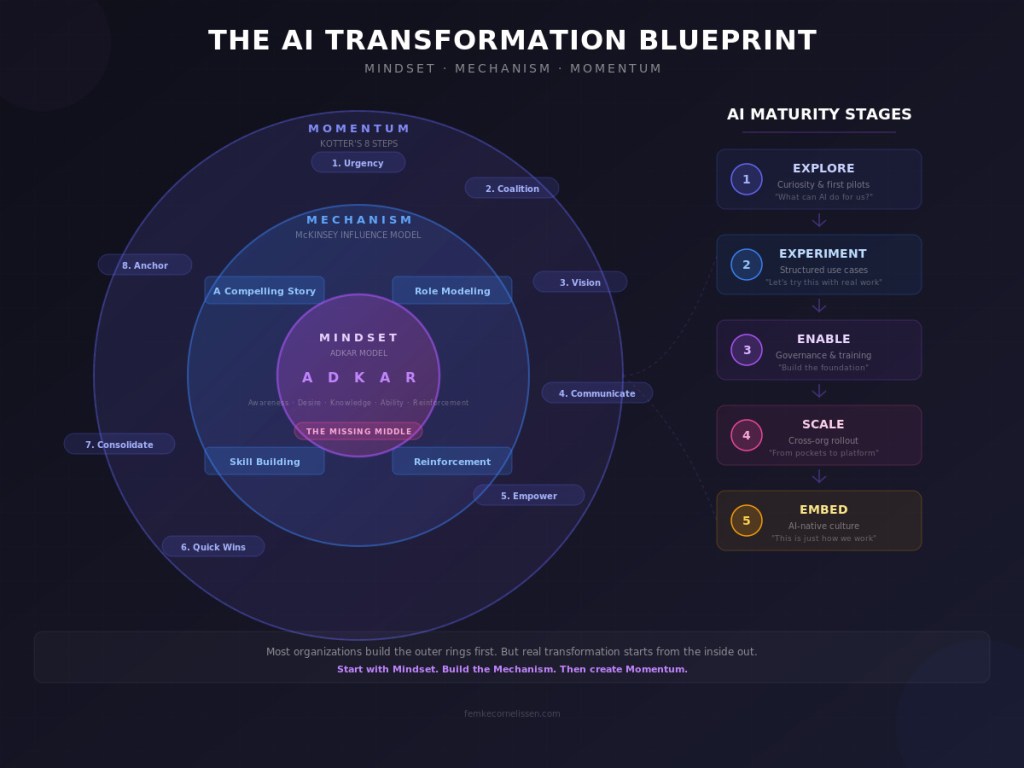
ADKAR — the Prosci model — is about the individual. Awareness, Desire, Knowledge, Ability, Reinforcement. It maps the internal journey a person goes through when something in their work changes. Most organizations skip Desire entirely. They assume that if people know about the tool, they’ll want to use it. That’s not how humans work.
McKinsey’s Influence Model zooms out to the environment. It asks: is the story compelling? Are leaders role-modeling the behavior? Do people have the skills? Are the systems reinforcing the change? Four levers. Most rollouts pull one, maybe two. Usually training plus a town hall. That’s not enough.
Kotter’s 8 Steps gives you the sequence. Create urgency. Build a coalition. Generate wins. Anchor it in culture. It’s the playbook for sustaining momentum once change starts moving. The problem is that most organizations never get past step two. They announce the change and wait for it to land.
Separately, each model tells part of the story. Together, they tell the whole thing. So I started combining them.
The AI Transformation Blueprint
I built this framework not as an academic exercise, but because I needed something that actually worked in the rooms I was in. A way to diagnose where things were breaking and why.
It has three layers, and they work like concentric rings.
The inner ring is Mindset. This is ADKAR territory. It’s about the individual. It starts with one person asking a question that no dashboard captures: What’s in it for me?
If you can’t answer that question for every role you’re rolling Copilot out to… not generically, but specifically… you’re building on sand. A finance analyst needs a different answer than a project manager. A sales lead needs a different answer than an HR business partner. “It makes you more productive” is not an answer. It’s a brochure.
The middle ring is Mechanism. This is McKinsey’s territory. It’s the organizational design around the person. Is the leadership team actually using Copilot, or are they delegating it to their assistants? Is there a space to share what works and what doesn’t? Are the systems rewarding new behavior or punishing experimentation?
I worked with one organization where the IT team built a beautiful Copilot learning path. Twelve modules. Certificates. The whole thing. Usage went up for two weeks and then flatlined. When I asked people why, the answer was always the same: My manager doesn’t use it. So it doesn’t feel like it matters.
Role modeling and keep sharing.. is not optional. It’s structural.
The outer ring is Momentum. This is Kotter. It’s about the sequence and speed of change across the organization. Are you creating early wins that people can see and feel? Are you communicating what’s working, not just what’s planned? Are you anchoring the new way of working into how the organization actually operates. In processes, in governance, in promotion criteria?
Most organizations never reach this ring. They get stuck somewhere between announcing the change and waiting for it to happen.
The Missing Middle
Here is the thing I see go wrong every single time. Organizations build the outer rings first. They create playbooks. They launch campaigns. They run training sessions. They set up governance frameworks. But they skip the center. They never answer the only question that actually matters: Why should I change how I work?
I call this the Missing Middle. It’s the gap between what the organization wants to achieve and what the individual is willing to do differently. And no amount of training, communication, or executive sponsorship will close it if you don’t address it directly.
The Missing Middle is not a skills gap. It’s a motivation gap. It’s the space between knowing how to use a tool and choosing to let it change your work.
And it’s invisible in every dashboard I’ve ever seen.
What the maturity curve actually looks like
When I overlay this framework on the organizations I work with, a pattern emerges. There are roughly five stages of AI maturity, and most organizations are stuck in the second one.
Stage 1: Explore. The organization is investigating AI. There are conversations, maybe a few pilots. No real commitment yet. This is where most organizations were eighteen months ago.
Stage 2: Experiment. Licenses are purchased. Training is delivered. A few teams are using Copilot regularly. Usage metrics exist. This is where most organizations are right now. And this is where they get stuck. Because everything looks like progress.
Stage 3: Enable. This is where the middle ring activates. Leaders are visibly using the tools. There are feedback loops. The organization starts designing around AI, not just layering it on top of existing processes. Few organizations have reached this stage.
Stage 4: Scale. AI is embedded across multiple functions. The org chart starts shifting. New roles emerge. Some roles disappear. Agents begin handling routine work. This requires the outer ring governance, momentum, structural change.
Stage 5: Embed. AI is how the organization operates. Not a project. Not an initiative. The default. Human-AI collaboration is assumed, not aspirational. I have not seen any organization fully reach this stage yet. But the ones in stage 3 and 4 are getting close.
The jump from stage 2 to stage 3 is the hardest. Because it requires going from deploying a tool to redesigning work. And most organizations don’t have a playbook for that.
That’s what the AI Transformation Blueprint is for.
What this means in practice
If you’re leading a Copilot rollout or any AI transformation right now, here’s what I’d suggest.
Start from the inside out. Don’t begin with the governance framework or the training plan. Begin with the question: for the first 50 people who will use this tool, what specifically changes about their day? If you can’t describe that in one sentence per role, you’re not ready to scale.
Make the story personal, not organizational. “We’re transforming how we work with AI” is a leadership message. “You will never have to write a status report from scratch again” is a personal message. The second one works. The first one doesn’t.
Invest in the middle ring before the outer ring. Role modeling, peer learning, and reinforcement systems matter more than training programs. The training gets people started. The environment determines whether they continue.
Measure behavior, not adoption. Stop looking at monthly active users. Start asking: Are meetings shorter? Are documents produced faster? Are decisions made quicker? Those are business metrics. And they’re the only ones that tell you whether anything actually changed.
Be honest about where you are. If you’re in stage 2, that’s fine. But don’t pretend you’re in stage 3. The worst thing you can do is celebrate the dashboard while the organization underneath hasn’t moved.
Why this matters to me
I’ve been building this framework because I got tired of watching good technology fail because of bad change management. I’ve seen it too many times. The tools work. The strategy is sound. The budget is approved. And twelve months later, people are still doing the same work in the same way, just with a more expensive license.
That’s not a technology failure. It’s a human systems failure. And it’s fixable.
Somewhere in the process of working on this, the framework became more than a model to me. It became how I think about every transformation I touch. Not because it’s perfect. But because it forces you to start where change actually happens: with a person, sitting at their desk, deciding whether to do something differently today.
That’s the Missing Middle. And that’s where the work begins.
 Femke Cornelissen