
t’s everywhere right now. Every leadership call, every strategic meeting, every partner conversation: “What’s the ROI of Copilot?” It’s a fair question. Budgets are under pressure, leaders want measurable impact, and people want to see results.

But here’s the truth: most organizations can’t measure it. Not because Copilot isn’t delivering value, but because their data isn’t ready to show it. That’s why the new Viva Insights report for Copilot Studio Agents caught my attention. It finally gives us a way to connect usage and outcomes. But if your tenant data isn’t in order, even the smartest dashboard will stay silent.
A big step. If you’re ready for it
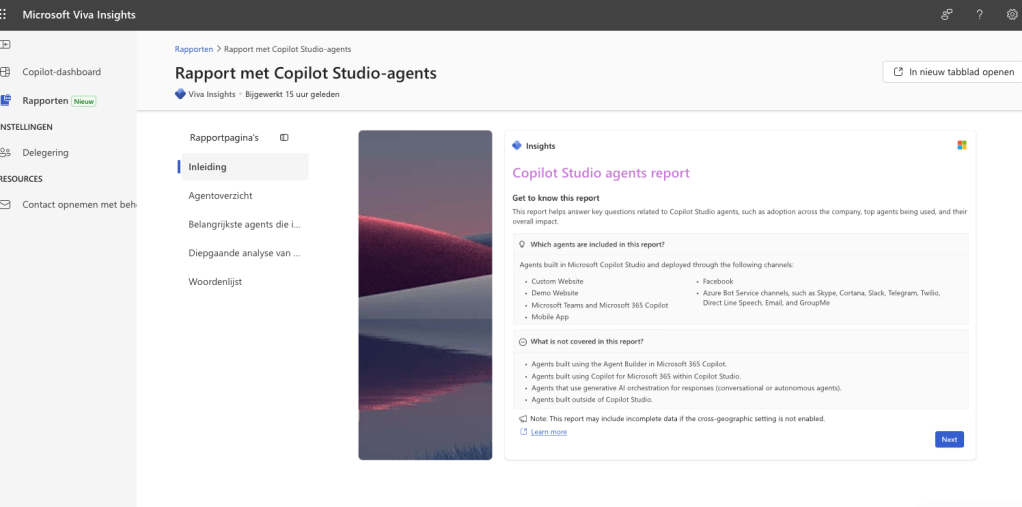
The new Copilot Studio Agents report inside Viva Insights shows which agents are used across your organization, where they’re deployed, and how adoption evolves over time. It’s a crucial step forward in understanding how AI is actually being used. Not just where it’s available. But here’s the challenge: Viva can only measure what your data allows. If your organization data in Entra ID, Copilot licenses, and telemetry aren’t properly set up, your dashboard will only ever tell part of the story.
What I keep seeing in organizations
Many leaders want ROI dashboards, but very few have the underlying structure to support them.They want to see outcomes, but haven’t yet built the foundation that makes those insights reliable.If organizational attributes in Entra ID aren’t mapped correctly, if Copilot telemetry isn’t enabled, or if licenses are assigned to inactive users, the data becomes noise.The dashboard might look impressive — but it won’t tell you what’s really happening.
What needs to be in place
To measure ROI effectively, these are the key ingredients that make the difference
1. Clean organizational data Ensure your Entra ID reflects reality. Departments, regions, roles, and managers must be correctly defined and updated.Without this, you can’t filter usage or see patterns.
2. Reliable license data Licenses should be linked to active users only. Remove test accounts, enable telemetry, and align user data with HR records.
3. Viva Insights configuration Upload or connect your HR data so you can analyze adoption by department, country, or role. Without it, you’ll only see aggregated tenant data. And that hides the real story.
4. Copilot Studio telemetry Enable telemetry within Copilot Studio to capture where and how agents are being used.This data powers the new reports inside Viva Insights.
5. Governance and privacy Activate organizational consent in Viva Insights so data can be aggregated and anonymized securely.
When everything connects
When these elements come together, something shifts.Dashboards stop being static visuals and start becoming real tools for insight.You’ll see which departments adopt Copilot fastest, which agents deliver the most value, and how collaboration patterns evolve.That’s when ROI becomes tangible. Not as a number, but as a narrative about how work is changing.
I am part of a study that goes deep into measuring ROI from Copilot. We’re already seeing what’s coming in the next generation of dashboards and learning. And one message stands out clearly: you can’t measure ROI if your data isn’t ready to speak. So before you chase the numbers, invest time in your foundation. Make sure your tenant data, telemetry, and structures are ready, so when the dashboards come, they’ll show the story you want to tell.
My reflection
Everyone is pressing for ROI on Copilot. But ROI isn’t something you download from a report. It’s the outcome of how ready your organization is to connect, clean, and trust its data. Before asking, “What’s the ROI of Copilot?”, ask yourself,“Is our data ready to prove it?”
Because the organizations that prepare now will be the ones leading later. Femke Cornelissen
Een gedachte over “Everyone is pressing for ROI on Copilot. But is your data ready to prove it?”
Reacties zijn gesloten.